 EN
EN  FR
FR 

Powered by ARTEFACT
Alumni Story : Thomas enrichit son parcours IA avec des compétences en data science
PROMO 2026
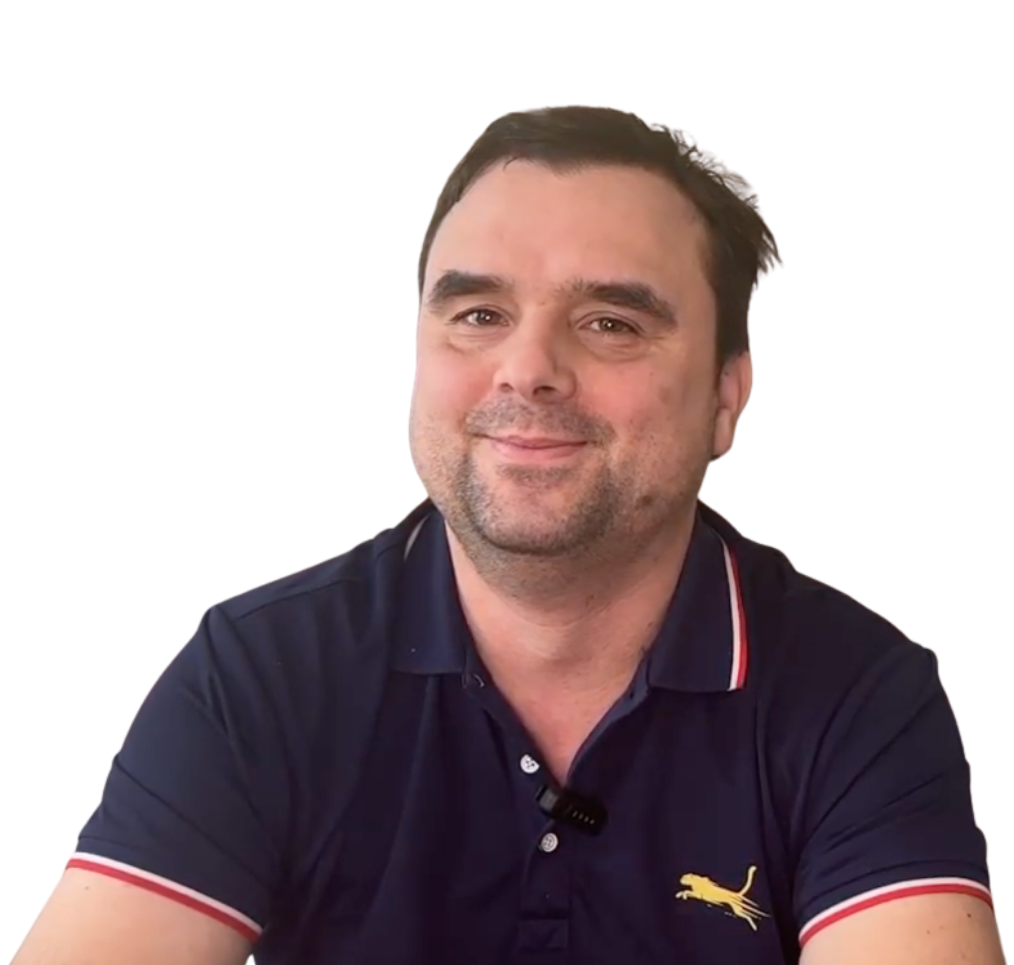
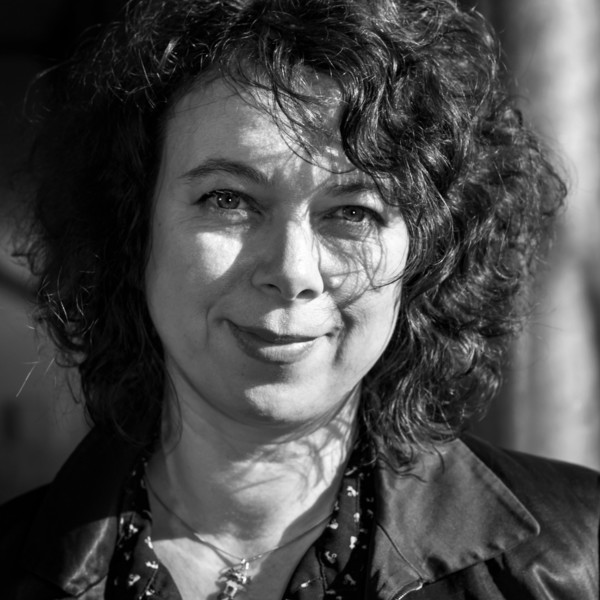
Thomas Hebert
Read the inspiring testimonial from Jaimes, an alumnus of the Data Science & AI training !
What was your background before joining the Data Science & AI course?
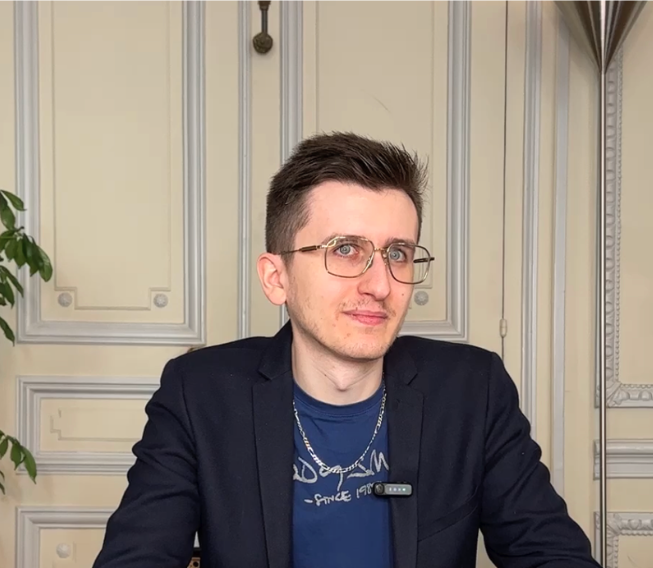
Je m’appelle Thomas, j’ai 26 ans, je suis diplômé du Master Android à Sorbonne Université. C’est un Master qui traite de l’IA appliquée à la robotique, aux environnements virtuels, aux systèmes multiagents et à l’aide à la décision. Avant de faire cette formation, j’étais consultant en financement d’innovation pour les entreprises. La différence, c’est que mon Master est plus orienté sur l’aspect d’innovation et recherche. À l’époque, quand j’ai dû faire le choix du Master, j’avais le choix entre ça et un Master plutôt orienté Data. Mon choix s’est porté sur le choix du cœur, sachant que quand j’avais fait mes recherches, c’était il y a de ça quatre ans maintenant, le marché était différent d’aujourd’hui. Il y avait plus de perspectives, plus d’emplois, pas mal d’entreprises en plein essor. Et ensuite, on a eu pas mal de différences qui sont arrivées par rapport à aujourd’hui. Ils ont recruté beaucoup de juniors, du coup il y a moins de place pour eux aujourd’hui sur le marché. Et puis l’IA aussi est arrivée, ce qui a pas mal bouleversé comment réagir face aux offres, comment repenser les différents jobs. Et aujourd’hui, c’est beaucoup plus des postes qui sont mixtes entre la recherche, la data et des postes de seniors qui sont plus recherchés. Donc là, j’ai besoin de pouvoir augmenter mon panel de compétences pour réussir à m’adapter au marché d’aujourd’hui.
Qu’est-ce que ton master ne t’avait pas apporté, que tu cherchais dans cette formation ?
Mon Master était très théorique, très dans les différentes formules, apprendre les différents concepts, parfois peut-être un petit peu en retard à la réalité du terrain par rapport à ce qu’on voyait et très orienté effectivement aux recherches, peut-être même un peu trop. C’est-à-dire que si on ne faisait pas de thèse à la fin du Master, ça restait quand même un peu compliqué pour trouver du travail, sachant que je suis sorti en 2024, donc c’était un peu difficile. Alors que la partie data, c’est quelque chose qui est plus orienté métier aujourd’hui, qui a une plus grande réalité du terrain, qui est quand même très demandée. Et ça, ce n’est pas quelque chose que j’ai vu du tout dans mon Master, donc j’avais vraiment besoin de faire ça.
Why did you choose Artefact School of Data?
Alors au départ, je ne connaissais pas du tout. Quand j’étais en poste l’année dernière, j’ai reçu un premier mail en juin de France Travail qui faisait la promotion de l’école. Et ça m’avait intrigué sur le moment, sauf que j’étais en poste, j’étais en pleine période d’essai, donc je ne pouvais pas vraiment faire ça. Je me suis dit peut-être plus tard, un jour, si jamais j’en ai besoin. Et puis en septembre, j’avais quitté mon poste à ce moment-là et France Travail me renvoie le même mail avec des nouvelles dates pour faire le webinaire. Et du coup, j’ai vu ça un peu comme un signe. Et puis je me suis dit, vu que pour l’instant, je n’ai rien à faire et que je sais que ça va quand même être difficile de trouver du travail, sachant que je cherchais un travail beaucoup plus technique, qui était beaucoup plus proche de ce que j’ai fait en Master plutôt que ce que j’ai fait dans mon ancien emploi. Je me suis dit que ce serait peut-être le bon moment pour pouvoir réussir à augmenter mes compétences et être beaucoup plus compétitif sur le marché.
How would you describe your experience at the School of Data?
Moi, j’ai trouvé ça très intéressant, sachant que je ne suis pas du tout habitué de base au format Bootcamp. C’est quelque chose que je ne connaissais pas du tout. Moi, j’ai toujours fait un parcours très classique en termes d’études. Je n’ai même pas fait d’alternance ou quoi. Moi, ça a toujours été un parcours initial, on va dire en ligne droite. Donc c’est vrai que cet aspect-là a été très nouveau pour moi. Et je trouvais ça très intéressant parce qu’on est beaucoup plus dans le réel, beaucoup plus dans un apprentissage rapide, alors que sur les parcours classiques, on fait beaucoup de théorie, toujours à étudier tout ce qui est formules, mathématiques derrière, sur de longues semaines, voire de longs mois. Là, on avait vraiment besoin de pouvoir connaître les notions, même pour des personnes qui n’avaient aucune base dans le domaine, rapidement en deux mois et demi. Donc je trouvais ça certes très intensif, mais quand même très intéressant et aujourd’hui beaucoup plus proche de la réalité métier parce qu’on se base quand même sur des technologies qui sont plutôt récentes et sur des domaines qui sont aujourd’hui très demandés dans les différentes offres.
What skills or tools did you learn during the course?
Au niveau de mes compétences surtout, et pas mal de compétences que je n’avais pas du tout, premièrement l’analyse de données. J’en avais fait un petit peu en licence, mais c’était quand même relativement limité. Là, on a vraiment vu l’importance de l’analyse de la donnée, comment faire, quels sont les différents points à prendre en compte, les différents dangers, qu’est-ce qui pouvait jouer sur l’apprentissage des modèles, etc. Je me suis aussi un peu perfectionné en SQL. Pareil, j’avais vu ça en licence, mais c’est quelque chose que je n’avais pas fait depuis un moment et sur lequel je me trouvais un peu faible. Donc là, ça m’a permis de pouvoir retravailler ça. On a aussi pu gagner plus de compétences en machine learning, parce que du coup, avec mon master, j’en ai eu, évidemment, on en fait. Mais ce n’est pas le même genre de machine learning qu’on fait. Nous, on fait plutôt du machine learning qu’on appelle par renforcement, où ce sont des petits agents autonomes qui vont apprendre de leurs erreurs par eux-mêmes pour essayer d’obtenir une récompense. Là, on cherche vraiment à faire quelque chose de guidé, de supervisé, ou même quelque chose d’un peu plus profond dans le deep learning pour traiter de la donnée pure et faire soit de la prédiction, soit de la classification pour avoir un résultat final qui est important pour le métier. Donc ça, ça change pas mal. Ça permet de pouvoir voir, entre mon parcours et le bootcamp, l’intégralité du machine learning avec tout ce que j’ai eu. Il y a ça, pareil pour le deep learning, quelque chose que j’ai vu à moitié, on va dire. Et puis, une partie, par contre, que je n’avais pas du tout faite, c’est la partie engineering qui est aujourd’hui très demandée, d’après ce que je vois sur Internet, toute la partie où on veut faire des pipelines construits, où tout est automatisé, on peut faire du déploiement sur le cloud, etc. Pour ensuite mettre à disposition les différentes applications ou les différents modèles pour les entreprises pour qu’elles puissent faire leurs prédictions automatiquement sans devoir retourner dans le code, lancer des programmes manuellement. Ça, c’est quelque chose que je n’avais pas du tout vu, parce qu’encore une fois, mes formations étaient très théoriques, donc il n’y avait aucune réalité métier derrière. Donc ça, ça m’a vraiment aidé pour pouvoir réaliser à quel point cette partie-là est importante.
Can you tell us about a project you did during the bootcamp?
Un mot pour décrire Artefact School of Data ?
Discover the success stories of our alumni
 Olivier Iberti


Get our training programme

PROMO 2026
Thomas Hebert
Read the inspiring testimonial from Jaimes, an alumnus of the Data Science & AI training !
What was your background before joining the Data Science & AI course?
My name is Thomas, I'm 26 and I'm a graduate of the Android Master's programme at Sorbonne University. It's a Master's degree that deals with AI applied to robotics, virtual environments, multi-agent systems and decision support. Before taking this course, I was an innovation financing consultant for companies. The difference is that my Masters is more focused on innovation and research. At the time, when I had to choose my Master's degree, I had the choice between that and a Master's degree that was more data-oriented. I chose the core option, bearing in mind that when I did my research, which was four years ago now, the market was different from today. There were more prospects, more jobs, quite a few companies booming. And then there were quite a few differences compared to today. They recruited a lot of juniors, so there's less room for them on the market today. And then AI came along, which changed quite a lot the way we react to offers, and how we rethink different jobs. And today, it's a lot more mixed jobs between research, data and senior positions that are more in demand. So I need to be able to increase my range of skills to adapt to today's market.
What didn't your Master's degree give you that you were looking for in this course?
My Master's was very theoretical, very much into the different formulas, learning the different concepts, sometimes perhaps a little behind the times compared to what we were seeing in the field and very research-oriented, perhaps even a little too much so. In other words, if you didn't do a thesis at the end of the Master's, it was still a bit complicated to find a job, bearing in mind that I graduated in 2024, so it was a bit difficult. The data part, on the other hand, is something that is more business-oriented nowadays, that has a greater real-world focus, and that is still very much in demand. And that's not something I saw at all in my Masters, so I really needed to do that.
Why did you choose Artefact School of Data?
I had done a benchmark of all the... a good proportion, I wouldn't say all, because I don't claim to have looked at everything, but I had seen a good proportion of the training courses specifically in everything to do with artificial intelligence, the creation of artificial intelligence, and the benchmark showed me that overall it was the one with the best marks and which had the most visibility, in inverted commas, both internationally and in France. So I said to myself, if we're going to have a course, we might as well have one that's being promoted by one of the French unicorns, which is Artefact. And having an in-house school is not bad. It gives it prestige.
How would you describe your experience at the School of Data?
So very interesting, very intense. There's a lot of work. I think it's a ten-week course, so there's a lot to learn. Every day we go over different things. You don't necessarily have enough distance to understand and grasp everything in the process. It's going to take a lot of work upstream and downstream, I think, just to acquire 100 % knowledge. But it's very comprehensive, and the two-week end-of-studies project is really interesting for that, because it allows us, with a group of other people who have done the course, to set up the whole process from A to Z, from data recovery to setting up the artificial intelligence platform, which again looks very good on a CV.
What skills or tools did you learn or reinforce during the course?
Ah, there are lots of them. I was already an engineer, so we were able to pick up some knowledge of Python. For people who hadn't done it, it's very important to at least have the basics to read it, because Vibe Coding is all very well, but if you don't understand what's going on, it's not as interesting. And after that, we were able to use TensorFlow, Pytorch, all the tools for creating artificial intelligence models, how to retrieve them, how to train them, and how to implement them on sites, buckets and so on. So it's very cross-disciplinary, and it allows you to see just about the entire process of the data scientist's job, from data collection to implementation on the Internet. So yes, making a list of everything we've learnt is likely to be a bit long. In any case, all you have to do is look at the training documentation to find out what's there.
Can you tell us about a project you did during the bootcamp?
The School of Data in a nutshell?
Bootcamp
About you
Thomas Hebert
remaining space
from at
Thank you for your application.
Next steps


Choose your session
PROMO 2026
Thomas Hebert
Read the inspiring testimonial from Jaimes, an alumnus of the Data Science & AI training !
What was your background before joining the Data Science & AI course?
My name is Thomas, I'm 26 and I'm a graduate of the Android Master's programme at Sorbonne University. It's a Master's degree that deals with AI applied to robotics, virtual environments, multi-agent systems and decision support. Before taking this course, I was an innovation financing consultant for companies. The difference is that my Masters is more focused on innovation and research. At the time, when I had to choose my Master's degree, I had the choice between that and a Master's degree that was more data-oriented. I chose the core option, bearing in mind that when I did my research, which was four years ago now, the market was different from today. There were more prospects, more jobs, quite a few companies booming. And then there were quite a few differences compared to today. They recruited a lot of juniors, so there's less room for them on the market today. And then AI came along, which changed quite a lot the way we react to offers, and how we rethink different jobs. And today, it's a lot more mixed jobs between research, data and senior positions that are more in demand. So I need to be able to increase my range of skills to adapt to today's market.
What didn't your Master's degree give you that you were looking for in this course?
My Master's was very theoretical, very much into the different formulas, learning the different concepts, sometimes perhaps a little behind the times compared to what we were seeing in the field and very research-oriented, perhaps even a little too much so. In other words, if you didn't do a thesis at the end of the Master's, it was still a bit complicated to find a job, bearing in mind that I graduated in 2024, so it was a bit difficult. The data part, on the other hand, is something that is more business-oriented nowadays, that has a greater real-world focus, and that is still very much in demand. And that's not something I saw at all in my Masters, so I really needed to do that.
Why did you choose Artefact School of Data?
So at first I didn't know anything about it. When I was in post last year, I got my first email in June from France Travail promoting the school. It intrigued me at the time, except that I was in post, I was in the middle of my trial period, so I couldn't really do that. I thought maybe later, one day, if I ever needed it. And then in September, I had left my job by then and France Travail sent me the same email with new dates for the webinar. So I took that as a sign. And then I thought, given that at the moment I've got nothing to do and I know that it's going to be difficult to find work, knowing that I was looking for a much more technical job, one that was much closer to what I did in my Masters rather than what I did in my old job. I thought that this might be a good time to increase my skills and be much more competitive on the market.
How would you describe your experience at the School of Data?
I found it very interesting, bearing in mind that I'm not at all used to the Bootcamp format. It's something I didn't know anything about. I've always taken a very traditional route in terms of my studies. I didn't even do a sandwich course or anything. It's always been a straight line, you could say. So it's true that this aspect was very new for me. And I found it very interesting because you're much more in touch with reality, much more involved in rapid learning, whereas on traditional courses you do a lot of theory, always studying all the formulae and mathematics behind it, over long weeks, even months. In this case, we really needed to be able to get to grips with the concepts, even for people who had no grounding in the field, quickly in two and a half months. So I found it very intensive, but still very interesting and now much closer to the reality of the business, because we're basing ourselves on technologies that are fairly recent and on areas that are very much in demand today in the various offers.
What skills or tools did you learn during the course?
In terms of my skills above all, and quite a few skills that I didn't have at all, firstly data analysis. I'd done a bit of it in my undergraduate degree, but it was still relatively limited. Here, we really saw the importance of data analysis, how to go about it, the different points to be taken into account, the different dangers, what could affect the learning of models, etc. I also honed my SQL skills a bit. Likewise, I'd seen it at undergraduate level, but it's something I hadn't done for a while and I felt a bit weak in it. So this enabled me to work on it again. We've also been able to gain more skills in machine learning, because with my Master's degree, I had some, obviously, we do some. But it's not the same kind of machine learning that we do. We're more into what we call reinforcement-based machine learning, where little autonomous agents learn from their mistakes by themselves to try and get a reward. Here, we're really looking to do something guided, supervised, or even something a little deeper in deep learning to process pure data and make either predictions or classifications to get a final result that's important for the business. So that's quite a change. It means that between my course and the bootcamp, I can see the whole of machine learning with everything I've learned. The same goes for deep learning, something I've only seen half of, so to speak. And then there's a part that I hadn't done at all, the engineering part, which is very much in demand these days, from what I've seen on the Internet, the whole part where you want to build pipelines, where everything is automated, you can deploy in the cloud, etc. And then make the various applications available to the public. Then we can make the different applications or models available to companies so that they can make their predictions automatically without having to go back into the code and run programs manually. That's something I hadn't seen at all, because once again, my training was very theoretical, so there was no business reality behind it. So that really helped me to realise how important that part is.
Can you tell us about a project you did during the bootcamp?
The School of Data in a nutshell?
Receive our detailed programme by email:
FAQ
Do you have any other questions about Artefact School of Data? We'd love to hear from you.
What is the difference between Artefact School of Data and other courses?
World-renowned learning and a unique educational experience. More than 5,000 students around the world have been trained by our experts atArtefact. You will benefit from immersion training with one of the world leaders in Data & AI, who will share their expertise with you. Every day, you'll learn from real-life cases you've worked on with some of the world's biggest companies.
How do I apply for our courses?
The registration process is very simple: you apply directly for the course of your choice, explaining your motivation and describing your career path. You can also download our full programme and make an appointment with our team.
How can I finance my training?
There are a number of funding solutions available to you: personal funding (in one or more instalments), use of your Personal Training Account (CPF), assistance from Pôle emploi, funding via your company's OPCO if you are in post, Professional Transition Project (PTP), Agefiph, etc. As each professional project and each funding application is unique, we offer you a personalised meeting to answer all your questions and help you through the process. You can also watch a video showing all the financing options available.
Are the courses face-to-face or distance learning?
We recommend taking the course face-to-face, in order to take full advantage of the learning environment within a leading player in Data and Artificial Intelligence, and to benefit from direct exchanges with the trainers and other participants.
However, for greater flexibility, our courses can also be taken at a distance or in a hybrid format. Every effort is made to ensure that you can participate in the best possible conditions, either from our classroom or from home, depending on your preference. This flexible format has been designed to optimise your learning throughout the course.
Who are the speakers at Artefact School of Data?
The lecturers at Artefact School of Data are senior Data Scientists, Data Analysts and Data Engineers. They all work forArtefactone of the world leaders in data. Thanks to their day-to-day work with Artefact's customers, they are confronted with the real and current issues faced by companies. This proximity to the field means that we can offer training that is rooted in the reality of data projects, built on their experience and the challenges they face every day.
Are our training courses Qualiopi certified?
Our training courses are certified "Qualiopi pour l'action de formation".
What support is there to help you find a job?
Every day, our students have the opportunity to work alongside Artefact employeesone of the leaders in the data industry. This means that every day, they meet Data Scientists, Data Analysts, Data Engineers and Data Marketing experts, who make up their team. professional network and increase their chances of securing a future position with Artefact or from one of our partners.